Updated: September 22, 2026
Originally tested: Systeme.io August 30, 2026 · beehiiv September 2026
Testing status: Hands-on tested
Disclosure: We may earn a commission if you sign up through some links on this page, at no additional cost to you. Affiliate relationships never affect our testing or recommendations.
Systeme.io vs beehiiv: Quick Answer
Choose Systeme.io if the email list is one part of something larger — an opt-in page, a funnel, a course, a checkout — and you want those in one account. Choose beehiiv if the newsletter itself is the product, and what you need around it is a publication, a subscriber list, and a way to send issues.
We built the same flow in both: a public signup page, a real submission from an address we control, the subscriber appearing in the dashboard, and an automated welcome email landing in Gmail. Both completed it. Neither needed a second tool.
The difference that matters most is how each one sends that welcome email, and what that means when you want a second one. Systeme.io sends it with an automation rule. beehiiv sends it with a preset welcome email — and on beehiiv’s free plan, that single preset is the whole of it, because Automations are not included.
Try Systeme.io free → · Try beehiiv free →
Systeme.io vs beehiiv at a Glance
| Item | Our take | Status |
|---|---|---|
| Best for | Systeme.io: an opt-in page that feeds a funnel. beehiiv: running the newsletter itself | Editorial judgment |
| Plan we tested on | Systeme.io: Free. beehiiv: Max trial. Not a like-for-like plan test | Hands-on tested |
| Signup to welcome email | Completed in both, with the email reaching Gmail | Hands-on tested |
| How the welcome email is sent | Systeme.io: an automation rule. beehiiv: a preset welcome email | Hands-on tested |
| Extra step at signup | beehiiv asked for a confirmation code; Systeme.io did not | Hands-on tested |
| Where we got stuck | Systeme.io showed its default page instead of our thank-you page | Hands-on tested |
| Multi-email sequences, free plan | Systeme.io: one rule, and its documentation shows a rule subscribing a contact to an email campaign that sends a series. beehiiv: Automations not included | Researched, not tested by us |
| Free plan list size | Systeme.io: 2,000 contacts. beehiiv: 2,500 subscribers | Researched |
| Newsletter sending | We sent one in beehiiv | Hands-on tested / Not tested |
How We Tested Systeme.io and beehiiv
We ran the same five steps in each tool:
Public signup page → a real submission from an address we control → the subscriber appears in the dashboard → an automated welcome email fires → the email arrives in Gmail.
The plans were not the same, and that matters. Our Systeme.io test ran on the Free plan, in August 2026, and is documented in full in our Systeme.io review. Our beehiiv test ran on the Max trial — the paid tier’s free trial, not the free Launch plan. During the test beehiiv’s own banner read “Your free trial expires in 13 days.”
So this is a comparison of the same task in two tools, not a test of their two free plans against each other. Where we describe what a free plan allows, we say where that came from: the limits screen in our own account, or the vendor’s documentation. We flag which, every time. Anything beyond those five steps — Systeme.io’s email campaigns, payments, courses, webinars, communities, API or webhooks; beehiiv’s Automations, ad network, paid subscriptions, referral program, polls or A/B testing; deliverability at volume, sender authentication, behaviour with mail providers other than Gmail, long-term reliability, support quality or either platform’s migration tooling — is read from official documentation.
One more asymmetry, stated up front: we sent a newsletter issue in beehiiv and did not do the equivalent in Systeme.io. That section describes beehiiv only.
Signup Page: A Funnel Step vs a Publication Page
Both gave us a public page with an email field in minutes. What they consider that page to be is where they separate.
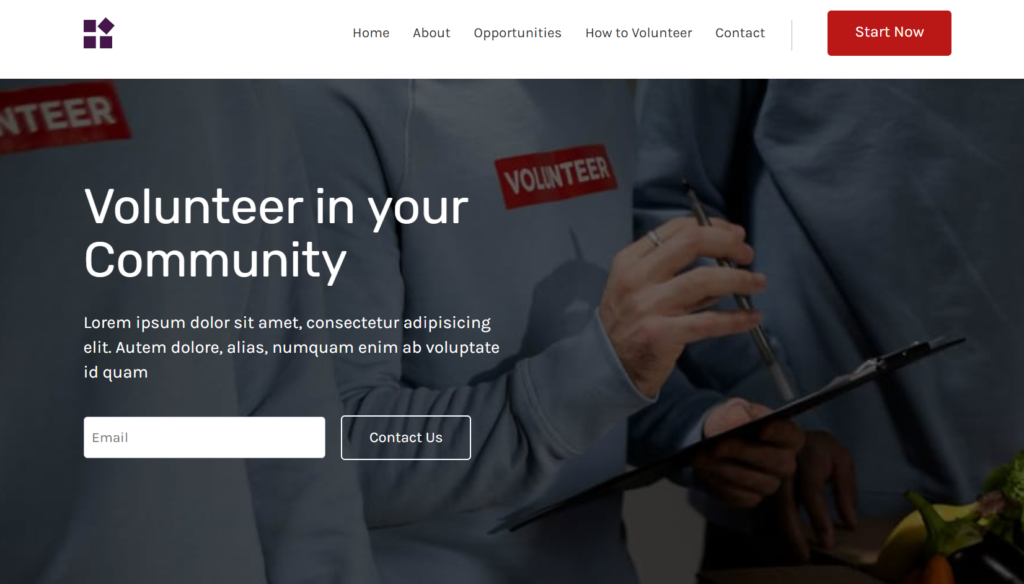
In Systeme.io, the page is a step in a funnel. We created a funnel called SmartToolCompass Test Funnel with two steps — an opt-in page and a thank-you page — and built the first from one of Systeme.io’s templates, which already carried an email form. Publishing it made it reachable at a public URL.
In beehiiv, the page belongs to a publication. There is no funnel wrapped around it; the signup page is the front door to the newsletter you are running.
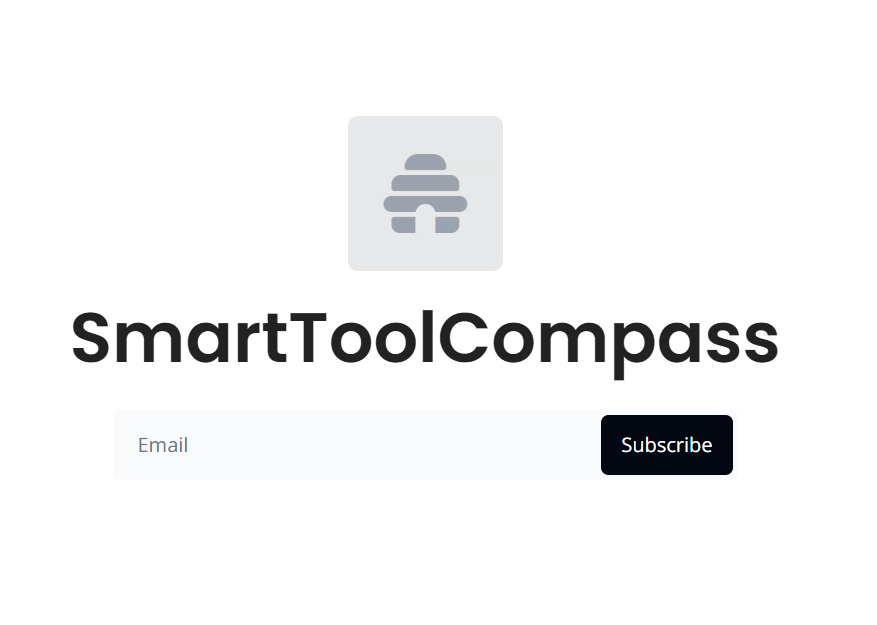
Neither approach is better in the abstract. They answer different questions. Systeme.io assumes the signup is a step toward something else you are building. beehiiv assumes the signup is the thing.
Capturing a Subscriber: beehiiv Added a Confirmation Step
We submitted each form as a visitor would, using a real address we control.
Systeme.io. The submission went straight through, and the contact appeared in the dashboard recorded as having subscribed on the opt-in page. That is the event the automation rule was waiting for.
beehiiv. The signup asked us to enter a confirmation code before the subscription completed. Once we did, the subscriber showed up in the Subscribers list with an Active status.
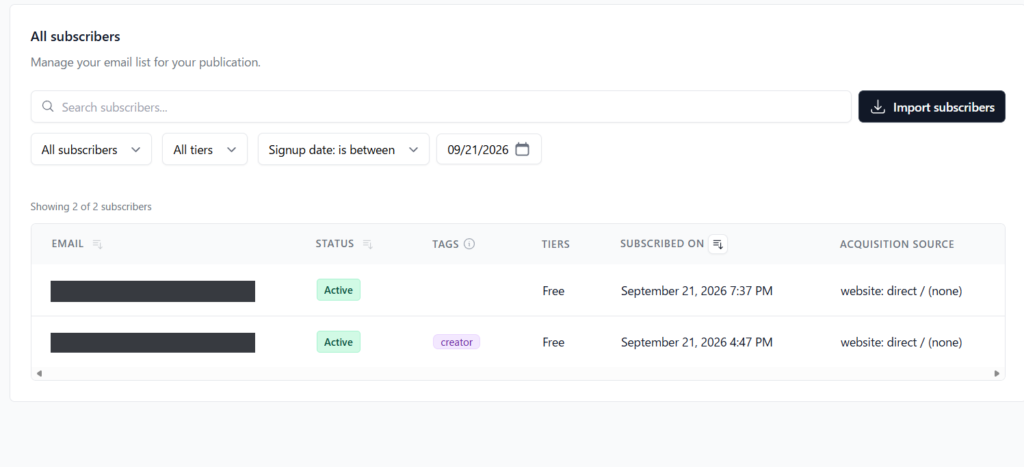
That extra step is a real difference in the visitor’s experience, and it cuts both ways. It adds friction to a signup — one more thing between a reader and your list. It also means the addresses that make it through have been confirmed by someone with access to that inbox. Which of those matters more depends on whether you are optimising for list size or list quality.
Welcome Email: Two Different Mechanisms
This is the part worth describing precisely, because the two tools reach the same result along different routes — and the route decides what happens when you want more.
Systeme.io: an automation rule. We configured one rule with a single trigger and a single action:
| Setting | Value |
|---|---|
| Trigger | Funnel step form subscribed |
| Funnel | SmartToolCompass Test Funnel |
| Funnel step | Opt-in page |
| Action | Send email |
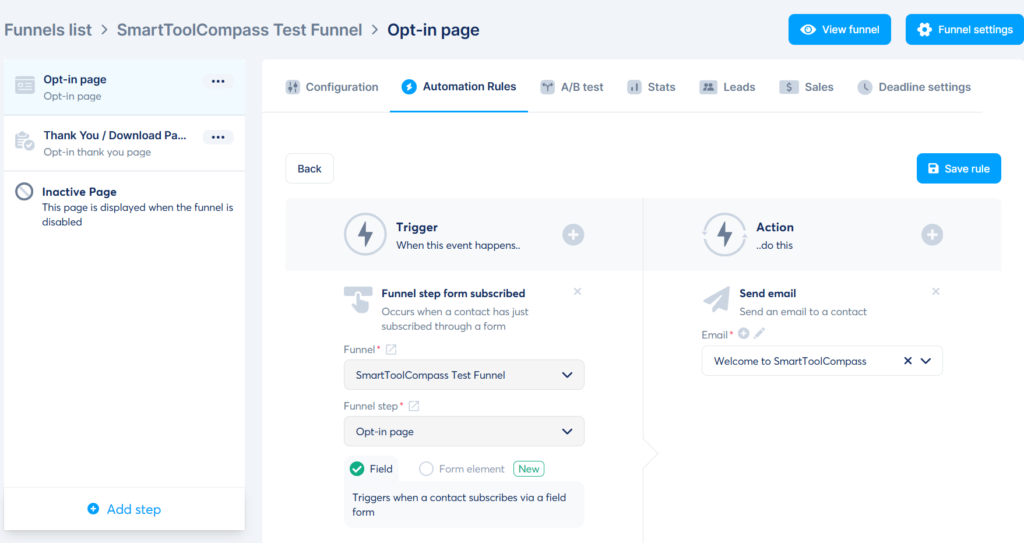
It sits in the same place as every other rule you might build. The welcome email is not a special category — it is one rule among however many your plan allows.
beehiiv: a preset welcome email. We set ours under Settings → Emails → Preset emails, wrote the message, and switched it on. There is no trigger to choose and no action to pick, because the trigger is fixed: someone subscribes, this email goes out.
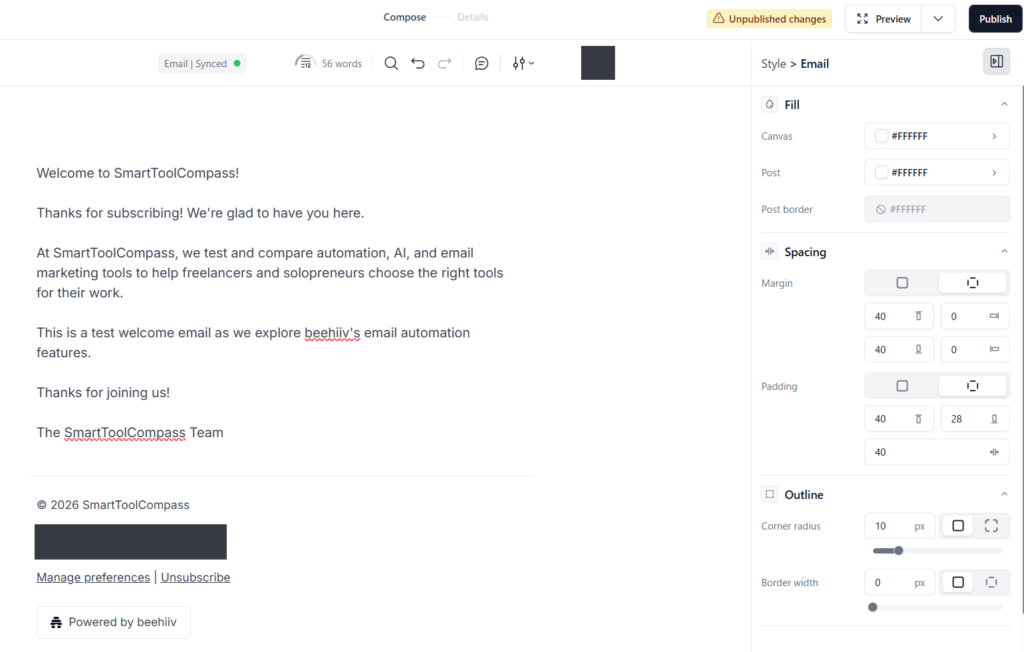
Less to configure, and less to get wrong. It is also a ceiling rather than a starting point, which the next section gets to.
Did Both Deliver?
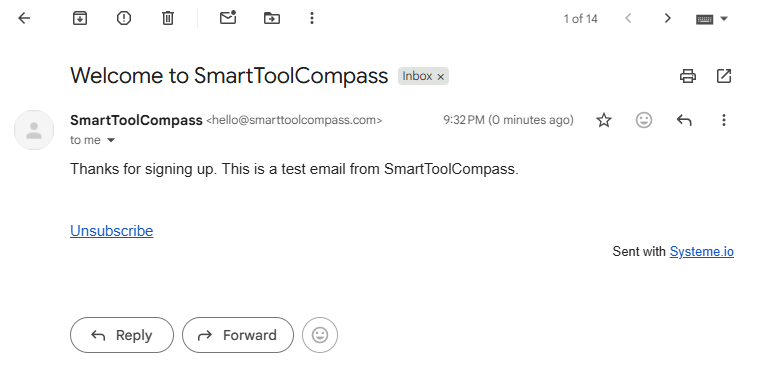
Yes. Both welcome emails reached our Gmail inbox.
Systeme.io. The message arrived with the subject “Welcome to SmartToolCompass,” sent from hello@smarttoolcompass.com, carrying a “Sent with Systeme.io” footer. Per Systeme.io’s Help Center that footer is an affiliate link promoting Systeme.io, and Free plan accounts cannot remove it — removing it requires a paid plan.
beehiiv. The preset welcome email arrived after we completed the confirmation step.
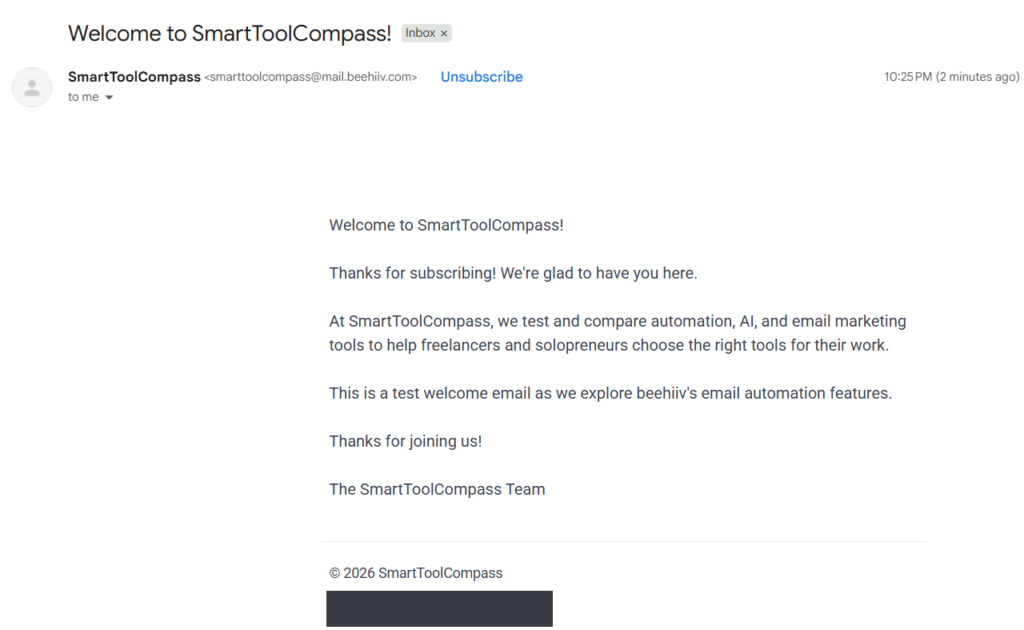
One clarification, because it would be easy to blur: the beehiiv email we received came from the preset welcome email, not from an Automation. We did build a “Signed up → Send email” workflow in beehiiv’s Automations section, but we did not activate or execute it. Nothing in this article reports the behaviour of a beehiiv Automation.
Both results are single tests, to one Gmail inbox. They show the path works end to end. They are not evidence about deliverability at volume or with other mail providers, and we are not claiming that.
The Setup Problem We Hit in Systeme.io
After submitting the Systeme.io form, we did not land on our thank-you page. Systeme.io showed its own message instead: “This page is displayed because a thank you page was not defined.” Our funnel did include a thank-you step.
We did not isolate the exact cause. Systeme.io’s documentation says the opt-in form’s button should be set to submit and redirect to the next step, and that a funnel without a custom thank-you page falls back to a default — so that is the first setting to check if you hit the same thing.
We hit nothing equivalent in beehiiv, but our beehiiv test did not include a post-signup redirect to a page of our own, so there was no comparable step to go wrong.
What the Free Plans Actually Allow
Everything above is about the first automation. This section is about the second one — and it is where the two free plans stop resembling each other.
Systeme.io’s Free plan. The limits screen in our own test account listed: 2,000 contacts, 3 sales funnels, 15 funnel steps, 1 automation rule, 1 workflow, 1 tag, 1 email campaign. Systeme.io’s official pricing FAQ adds 1 blog, 1 course, 1 custom domain, unlimited email sending, no credit card, and no expiry.
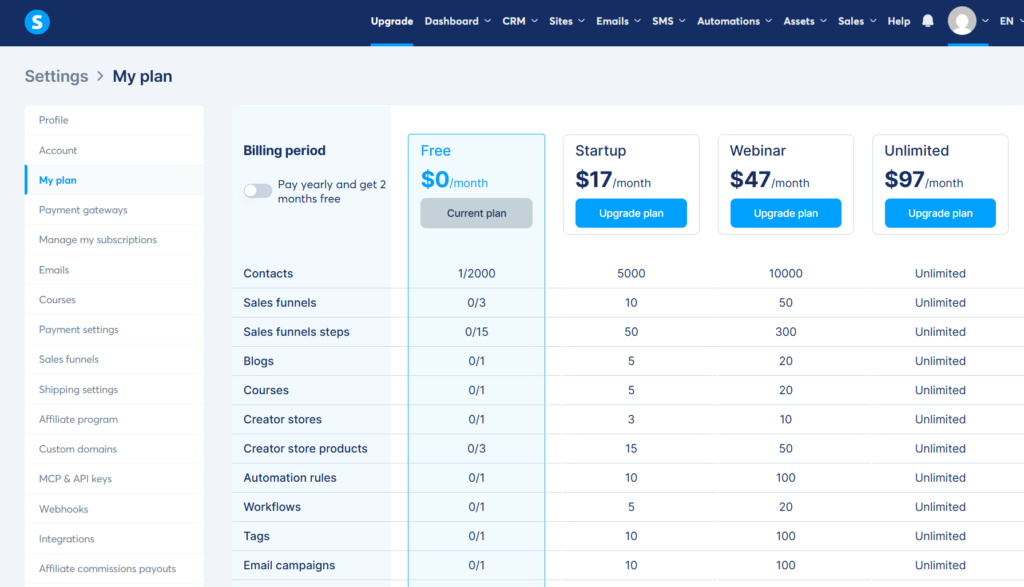
beehiiv’s Launch plan. Per beehiiv’s pricing page it carries up to 2,500 subscribers, unlimited email sends, and a custom domain. Automations are not included — beehiiv’s documentation puts them on “Scale plans and above.” The welcome email is the exception: beehiiv states it is “available on all beehiiv plans, including the free Launch plan.”
Both free tiers support an automated welcome email, but their limits differ. Systeme.io includes one automation rule and one email campaign; its documentation describes using a rule to start a multi-email sequence. beehiiv Launch includes a preset welcome email but not its general-purpose Automations feature. The two ceilings sit in different places:
- Systeme.io gives you the general-purpose mechanism and allows exactly one of it. Your one rule can be anything a rule can do; a second rule needs a paid plan.
- beehiiv gives you the welcome email as a fixed feature and withholds the general-purpose mechanism entirely. You cannot spend your one automation differently, because on Launch there are no automations to spend.
Our editorial judgment: for a freelancer, Systeme.io’s single rule is the more flexible of the two constraints, and beehiiv’s fixed welcome email is the more predictable. If your second automation is a lead-magnet delivery for a different opt-in page, Systeme.io’s one-rule ceiling arrives quickly. If all you will ever send automatically is one greeting, beehiiv’s version is less to maintain. Note that Systeme.io’s one rule is not the same as one email: its documentation has a rule subscribe the contact to an email campaign, which then sends a series.
Newsletter Sending: We Only Tested beehiiv
Sending the issues is the job beehiiv is built around, so we tested it — and we did not run the equivalent in Systeme.io. Read this section as a description of beehiiv, not a comparison.
We wrote one newsletter post and sent it with beehiiv’s Email only option to two test addresses we control. Both copies arrived in Gmail.
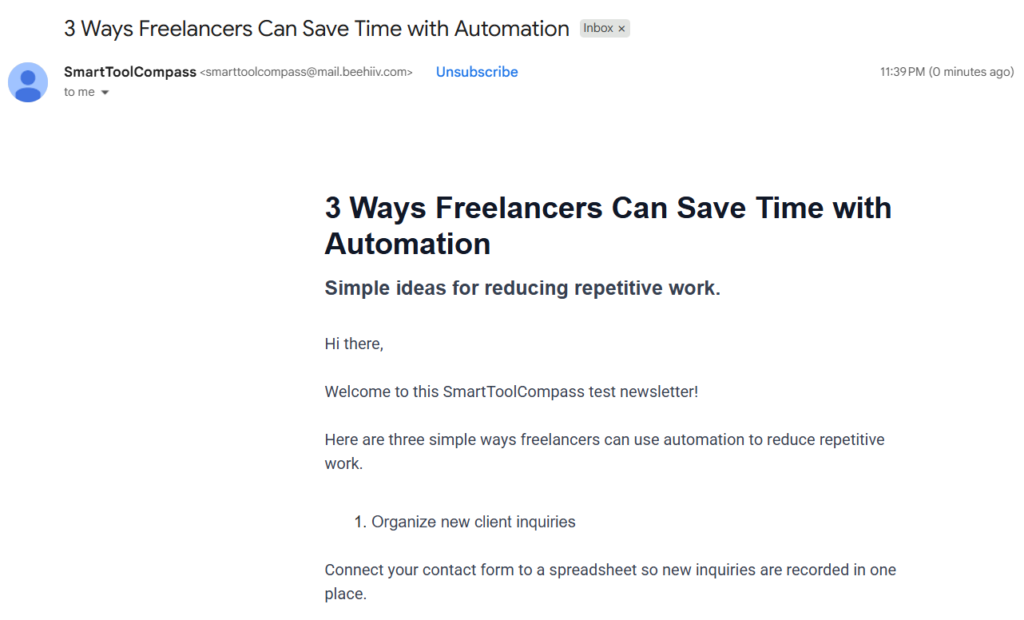
What that establishes is narrow and worth stating plainly: a post written in beehiiv reached real inboxes as an email. It says nothing about how either tool performs at list scale, about open rates, or about how Systeme.io’s email campaigns compare — we did not send one.
Systeme.io’s Free plan does list one email campaign on its limits screen, and its help centre documents an automation rule using a “Subscribe to campaign” action, so a single rule can start a series of emails rather than send only one. That is documented capability, not something we exercised: our own test sent a single welcome email with one rule, and we never built or sent a campaign.
Systeme.io vs beehiiv Pricing
Pricing checked on September 22, 2026, on the official pricing pages for Systeme.io and beehiiv. The figures below are monthly-billing prices for both tools, so the columns can be read against each other.
| Tier | Systeme.io | beehiiv |
|---|---|---|
| Free | Free — $0. 2,000 contacts, 3 funnels, 1 automation rule, 1 blog, 1 course, 1 custom domain, unlimited sends, no expiry, no card | Launch — $0. Up to 2,500 subscribers, unlimited sends, custom domain. No automations |
| Entry paid | Startup — $17/mo | Scale — from $49/mo billed monthly ($517/year, which works out to $43/mo) |
| Next tier | Webinar — $47/mo | Max — from $109/mo billed monthly ($1,151/year, which works out to $96/mo) |
| Top tier | Unlimited — $97/mo | Enterprise — custom |
| Annual discount | Advertised as “2 months free” | $517/year vs $49×12 monthly; $1,151/year vs $109×12 monthly |
beehiiv’s paid prices are entry prices: they rise as the subscriber count grows, so $49 and $109 are where Scale and Max start rather than what they always cost. The plans are also not equivalent packages, so the gap between $17 and $49 on monthly billing is not a like-for-like price difference. Systeme.io’s paid tiers bundle funnels, courses and checkout; beehiiv’s bundle publication features, automations and its ad network. Compare them against what you actually need rather than on the headline figure.
Which Is Cheaper?
For a freelancer starting out, both are $0, and the honest answer is that price is not the deciding factor at this stage. What decides it is which free ceiling you hit first.
- You will hit Systeme.io’s ceiling when you want a second automation rule — which, on a one-rule plan, is as soon as you run a second opt-in page with its own welcome email.
- You will hit beehiiv’s ceiling when you want any multi-step sequence at all, because Launch has no automations. A welcome email followed three days later by a second email is a Scale feature. Systeme.io’s free tier documents the opposite trade: one rule and one campaign, which on paper is enough for a short sequence from a single opt-in page.
- Neither ceiling is list size for most freelancers starting out. 2,000 and 2,500 are close enough that the difference is unlikely to decide this.
When you do upgrade, Systeme.io’s entry tier is the cheaper one on monthly billing — $17 against beehiiv’s starting $49. Whether that is the relevant comparison depends on whether you need what each tier contains.
Systeme.io Is Better If…
- The email list serves something else you are selling. The opt-in page is a funnel step, and the funnel can carry a thank-you page, a course, or a checkout in the same account.
- You want the general-purpose automation mechanism on a free plan. One rule is restrictive, but it is a real rule — trigger and action of your choosing.
- You want a signup with no confirmation step. In our test the submission went straight through to a created contact.
- The upgrade price matters more than the feature set. $17/mo against beehiiv’s starting $49/mo, both on monthly billing.
beehiiv Is Better If…
- The newsletter is the product. Writing and sending issues is the centre of the tool, not a feature beside the funnel builder.
- You want the welcome email to be one switch. No trigger to choose, no action to configure, nothing to point at the wrong funnel step.
- You would rather confirm addresses than maximise signups. The confirmation code adds friction and filters the list at the same time.
- A slightly larger free list matters. 2,500 subscribers against 2,000 contacts.
Systeme.io vs beehiiv for Freelancers
Two questions settle this for most freelance work, and neither is about features.
Is the list a means or an end? If people join your list so you can sell them something you build elsewhere in the same tool, Systeme.io’s shape fits. If people join because they want to read what you send, beehiiv’s does.
What is your second automation? This is the question we would ask before signing up for either. Write it down now. If it is a second welcome email for a second opt-in page, Systeme.io’s free tier runs out at that exact point, because that is a second rule. If it is a sequence from the same opt-in page — greeting now, something else in three days — beehiiv’s free tier never had it, while Systeme.io documents a way to do it with its one rule and one campaign.
What did not separate them, on the evidence of our builds: getting the first automated email working. Both did it, on one account, without a second tool.
Final Verdict
Both tools took us from a public signup page to a welcome email in a real inbox, and neither required a second service to do it. On that task they are equals, and our tests say so directly.
Where they separate, we are reasoning from documented plan limits rather than from our builds, because our two tests ran on different plans. Systeme.io suits the freelancer whose list feeds a funnel — its free tier includes the general automation mechanism, capped at one rule, and its paid entry is cheaper. beehiiv suits the freelancer whose newsletter is the product — its welcome email is documented as available on every plan including the free one, and sending issues is what the tool is organised around.
The thing we would not do is choose between them on which one “has automation.” The distinction is not simply whether either tool can send an automatic email. Systeme.io’s free tier includes one general-purpose automation rule and one email campaign, while beehiiv Launch provides a preset welcome email without access to its Automations feature. We tested one welcome email in each tool, not a multi-email sequence.
Try Systeme.io free → · Try beehiiv free →
FAQ
Can you send an automated welcome email on both free plans?
Yes, by different means. Systeme.io’s Free plan includes one automation rule, which is what we used. beehiiv’s documentation states the welcome email is available on all plans including the free Launch plan — though our own test ran on the Max trial, not on Launch.
Does beehiiv’s free plan include automations?
No. beehiiv’s documentation places Automations on “Scale plans and above.” The welcome email is separate from Automations and is available on Launch. In our test on the Max trial, we built a “Signed up → Send email” workflow but did not activate or execute it.
Which free plan holds more people?
beehiiv Launch lists up to 2,500 subscribers; Systeme.io Free lists 2,000 contacts. Both advertise unlimited email sending. For most freelancers starting out, the automation limits will bite before the list limits do.
Which is cheaper to upgrade?
On monthly billing, Systeme.io’s Startup plan is $17/mo against beehiiv’s Scale, which starts at $49/mo and rises with subscriber count. The tiers contain different things — funnels and courses on one side, publication features and automations on the other — so this is a price difference rather than a value comparison.
Does Systeme.io put branding on free plan emails?
Yes. Our welcome email arrived with a “Sent with Systeme.io” footer. Per Systeme.io’s Help Center that line is an affiliate link and cannot be removed on the Free plan; removing it requires a paid plan.
Did the signup work the same way in both?
Not quite. beehiiv asked for a confirmation code before the subscription completed; Systeme.io’s submission went straight through to a created contact. Both ended with a subscriber recorded and a welcome email delivered.
Did you test sending a newsletter in both?
No. We sent one issue in beehiiv to two addresses we control and confirmed both arrived in Gmail. We did not send the equivalent in Systeme.io, so this article makes no claim about how its email campaigns compare.
Sources & Verification
Hands-on tests: the Systeme.io build is documented in full in our Systeme.io review — tested August 30, 2026 on the Free plan and re-verified September 18, 2026. The beehiiv build was run in September 2026 on the Max trial, with the account showing “Your free trial expires in 13 days” during the test.
Official sources (checked September 23, 2026):
- Systeme.io pricing page and pricing FAQ — Free plan contacts, funnels, custom domain, blog, course, unlimited sends, no expiry and no card required
- beehiiv pricing page — Launch subscriber cap, unlimited sends, custom domain, and the plan prices quoted above
- beehiiv Help: Welcome email vs. welcome automation — “It’s available on all beehiiv plans, including the free Launch plan” and “Automations are available on Scale plans and above”
- Systeme.io Help Center — the “Sent with systeme.io” footer on Free plan emails, and the thank-you page default behaviour (both linked from our Systeme.io review)
- Systeme.io Help Center: How to automate the sending of an email sequence — an automation rule with a “Subscribe to campaign” action starts a series of emails. Documented, not tested by us
Not verified by us: beehiiv’s free Launch plan (our test ran on the Max trial), beehiiv Automations (built but never activated or executed), and Systeme.io’s email campaigns (never sent).


Comments